1st Royal Tank Regiment Historical & Interest Notes
Of A More Topical Nature Than The Official History
created: 24 Jan 2003 Updated & Closed: 5 September 2003 Page 2 - Click Here


| 1. | Lord Carver |
| 2. | Death on Salisbury Plain |
| 3. | Lord Carver met C Sqn |
| 4. | Newspaper item on 1 RTR |
| 5. | Tank Museum Bovington - RTR Shop |
| 6. | 1 RTR come last in Band competition |
| 7. | Last Challenger 2 delivered to 1 RTR |
| 8. | Advert for Chieftain for sale |
| 9. | My service history |
| 10. | Tony Hart with Lord Mountbatten |
| 11. | Meet The Troopers! Newspaper Articles |
| 12. | Soltau For Nigs! |
| 13. | You Might be a Tankie If..... |
| 14. | Warminster & 1 RTR |
| 15. | Maxwell Address to the Lads in First Edition - Nov 74. |
| 16. | Aerial Image of St Georges Barracks, Sutton Coldfield |
| 17. | Victoria Cross - Royal Tank Regiment - Capt Gardner |
| 18. | German's Play Cricket - Yes Honest! |
| 19. | Lots of links to sites I have found whilst researching the Regiment. |
Field Marshall Lord Carver
|
|
Field Marshal Lord Carver, who died in December 2001, was the highest ranking Royal Tank Regiment officer of all time - the only one to reach the exalted rank of Field Marshal. At 27 he was commanding the First Royal Tank Regiment in North Africa, two years later, in 1944, he was promoted brigadier and given command of 4th Armoured Brigade which fought its way across north west Europe. The photograph (below) from Lord Carver's personal album shows the Sherman II (M4A1) command tank that he used when commanding the brigade. Lord Carver's post-war career was every bit as illustrious and he will also be remembered as a significant military historian. It is probably significant that his great, great, great uncle was another famous soldier, Arthur Wellesley, Duke of Wellington. |

http://www.warlinks.com/armour/4th_armoured/index.html


4th Armd Bde 7th Armd
Division (Click the Badges)

|
News Item from the BBC (Thanks to James Barclay) Jan 21 2003. Calls have been made for better training for soldiers after an inquest heard how two men died when they were crushed by a tank during a routine military exercise. Coroner David Masters made the recommendation after an inquest jury returned a verdict of misadventure on commander Lieutenant Paul Syred, 25, and 28-year-old operator Corporal Michael Paterson. The soldiers were trapped beneath their 70-tonne Challenger tank while taking part in a battle simulation on Salisbury Plain last July. Mr Masters accepted the jury's recommendations for more cross-country terrain training for drivers and a better mix of experienced and inexperienced staff on tank crews. Lt Syred and Cpl Paterson were part of a crew of four from The 1st Royal Tank Regiment playing the role of enemy forces in the training exercise with the King's Royal Hussars. The vehicle was reversing on a steep bank when it toppled over the edge, landing upside down in a mud-filled tank track, the jury at Salisbury Crown Court were told. The two men were standing with their heads out of the tank so they could direct the vehicle. Jurors heard how the pair would have had less than a second to duck back within the hull before it tipped over. Lt Syred had only recently completed his troop leader's course and was taking command of a tank for the first time. The lieutenant, from Sedbergh, Cumbria, died from multiple injuries. Cpl Paterson, from Bankfoot, Perthshire, died from head injuries. Trapped inside Driver Scott Christie had only recently completed his driver training. He hauled himself out of the vehicle after the accident and ran to raise the alarm. The fourth crew member, trooper Simon Hampton, 20, was trapped in the vehicle until rescue crews reached him. Military and police crash investigators could not discover exactly how the tank had veered off the track. The driver's vision is severely restricted and relies entirely on directions from his commander or operator in the turrets above. |


Two Troop C Sqn 1975

By a strange coincidence, considering the opening article on this page, here
we see Chief of the Defence Staff, Field Marshall Sir Michael
Carver talking to Tpr Woolley; Cpl Dixon and Sgt Westwood in March 1975.

Lancashire Evening Telegraph Nov 26th 1984
Look What I Found in The Tank Museum

Click on this image:


Tank Museum: This is the M24 Chaffee, painted up as
TRIGGER HAPPY of Headquarters Squadron,
1st Royal Tank Regiment, 22nd Armoured
Brigade,
7th Armoured Division as seen at the Berlin Victory Parade of 1945.
They even took
the opportunity to open up the engine covers and take a peek at those
twin Cadillac engines.


Lawrence of Arabia at Bovington and his grave in Moreton,
Dorset
(Copies of these can be purchased at The Tank Museum)
2002: Apparently the Band of The 1st Royal Tank Regiment has
been regraded from a 3a Band to a 3b Band, whatever that means?
In the World
Championships they came last of 27 Bands Competing in Grade 3a!!
http://www.rspba.co.uk/Press_Releases/271002.htm
http://www.rspba.co.uk/Worlds2002/grade3a.htm

|
THE last of the Army's 386 Challenger 2 battle tanks has entered service following its official handover near Warminster this week. Defence Procurement Minister Lord Bach was on hand on Salisbury Plain to witness the delivery of the £5m tank on Wednesday to A Squadron, the 1st Royal Tank Regiment based at Warminster from manufacturer Vickers Defence Systems. Lord Bach said: "Challenger 2 is an impressive, battle-winning tank that will offer a significant capability enhancement to the Royal Armoured Corps for many years to come." The first Challenger 2s entered service in 1998 and have already seen active service in the Balkans as well as being taken to Canada, Germany, Poland and Oman on training exercises. They will remain on front-line duties for the next 25 years. The regiment is one of six to be operating the new weapon, continuing a link dating back to 1917 when A Squadron became the first unit in the Army to be armed with tanks. Each of its Challenger 2s has a 120mm main gun and two machine guns and is powered by a 1,200bhp diesel engine. Archie Hughes, Vickers chief executive, said: "Challenger 2 has demonstrably proven to be the most reliable main battle tank in the world." |
Thanks to James Barclay for this one:
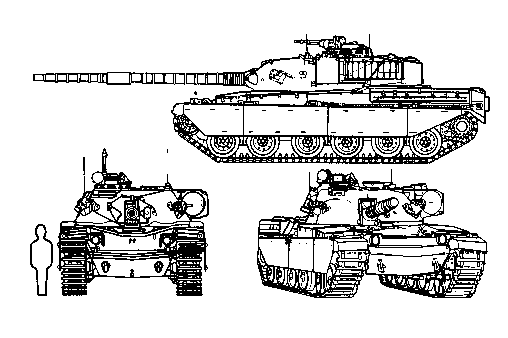
CHIEFTAIN TANK (demo sale)

|
British Army Chieftain Gun Tank. |
|
The Webmasters Service History
April 1st 1971 - Arrived at RAC Trg Regt Catterick
(Strangely enough I enjoyed the training - good fun!)
Clerical Training at Camberley. Whilst at Camberley, the Police arrived and got
all the lads searching the woods for a murderer; it was me and one other who found his
campsite. Biggest Regret: Not getting third tape or more. I wish things had worked out differently with 1 RTR. Overall: I would recommend army life to anyone - 1 RTR was a superb mob with some real characters! One or two bastards, but a great mob!! |
A Very Young Tony Hart With Lord Mountbatten of Burma
Meet the Trooper!TROOPER Michael O'Connor, of Bramble Way, Moreton, has completed full military training and is now a serving member of the 1st Royal Tank Regiment. To achieve this, Michael endured 11 weeks' rigorous work at the Army Training Regiment in Winchester, followed by a spell at Bovington, Dorset, where he specialised in communications, driving and maintaining Armoured Fighting Vehicles. You can meet Michael and find out about his Army experiences first hand at the Army Careers Office in Birkenhead from May 12-21. Where are you now Michael? I was from Moreton too. First published on Wednesday 16 April 1997: http://www.thisiswirral.co.uk/wirral/archive/1997/04/16/11823ZM.html TROOPER Mark Smith, from Noctorum, is now a serving member of the 1st Royal Tank Regiment after completing full military training. To achieve this, Mark endured 11 weeks' arduous work at the Army Training Regiment in Winchester, before moving on to Bovington, Dorset, where he tackled the more demanding topics of communications, driving and maintaining armoured fighting vehicles. Local lads interested in finding out more about the Army, can meet Mark from May 12-21 at the Army Careers Information Office in Grange Road West, Birkenhead, where he first enquired about joining the Armed Forces after leaving Ridgeway High School. First published on Thursday 24 April 1997 http://www.thisiswirral.co.uk/wirral/archive/1997/04/24/12150ZM.html |
|
The following article nearly found its way into ATO's hands as an undesirable package! I recently spent 15 hours rebuilding and reinstalling my entire pc. When I had sorted out all my old files, I found this in a zip file, thanks to Pete Corrigan for this article. These articles are taken from the Red Lanyard which covered the years from '89 to '93 and appeared under the heading of Excercises. We start with Maj Caraffi's references to Soltau terminology for the "NIG" . Colloquial Soltau(Or how to hold your own at any RAC
event 5 years from now) Rheinsehlen: DAMCON: Soltau. The end of a love affair -
Lt Woodstock. Unfortunately, Soltau can no longer
be used in the same carefree manner that our predecessors did, I bet that they
did not have to contend with the the constant fear of accidentally dropping a
few hundred litres of oil. I think it is safe to assume that they did not lose
sleep at night worrying about the amount of scratch marks that they had left on
the road or the fact that they may have left some mud on a junction.
Restrictions have been getting tighter, not just after the war, but even in the
last few years.Forty-eight years ago, the British Army had a huge area, millions
of square kilometres. Well I'm glad we won the war, I would have hated to see
what would have happened if we had lost, especially as Soltau appears to be the
prize for coming first.
|
|
the only ashtrays at home are 105mm shell casings. Thanks Pete Corrigan! |
|
British Army demonstrates its combined firepower - Warminster Gallery
By Peter Felstead, Jane’s Web Editor http://www.janes.com/defence/land_forces/gallery/warminster/warmin_intro.shtml Thanks again to Pete Corrigan. |
|
|
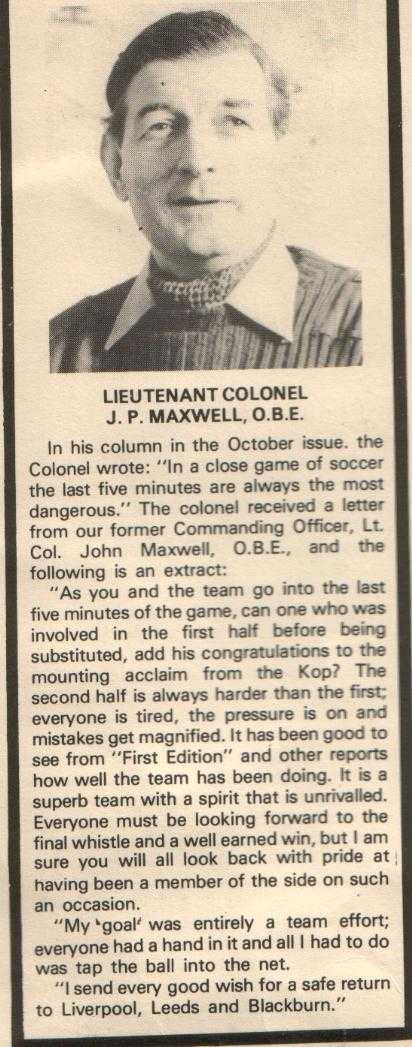
Lt Col Maxwell had many attributes but sadly one was not football (FOOTBALL Sir, NOT SOCCER!). Soccer is am Americanisation of the game. As this was the Col's final address in the First Edition prior to the Regiment leaving Omagh, I find it pretty naff to say the least. All the work that the Regiment had put into those 2 years looking after approximately half of the Northern Ireland/Eire border; all that which lay in between. The bombs, shootings, landmines, deaths to those supporting the Regiment, the own goals, the scares, the attack on the quarters (an attack against women and children), the car bombs, stress and strain. All the lads who were involved in this deserved a medal, and not just a GSM either. To fight in a war, you know who your enemy is; he wears a uniform and is "generally" where he is supposed to be but, in this conflict, the Regiment were up against cowards and misguided "fanatics" who were in the main trigger happy people in it only for the "kick". Sorry Sir - you analogy is out of tune with the lads and insulting to those of us who do not even like Liverpool FC!! |

|
An aerial image of what was St Georges Barracks, Sutton Coldfield, in this image demolished, and now all a brand new housing estate. The large white buildings are MOD Defence Estates - now surrounded by housing. The large demolished building was the Army School of Recruiting where I worked very happily until I left in August 1994. |

A drawing by Tpr D Wayne which appeared on the front page of the
First Edition - Nov 74
Royal Tank Regiment Victoria Cross

|
The Victoria Cross. The Victoria Cross is by far the world's most coveted medal for bravery. Although instituted more than a century ago and spanning the four most terrible wars in Britain's history, it has been awarded to only 1,350 men, three of whom have won it twice, plus one more for the American Unknown Warrior, who lies buried in Arlington National Cemetery, Washington, as a symbol for all those who died in the Allied cause. The British Unknown Warrior, who was buried in Westminster Abbey, received the Congressional Medal of Honor from the United States Government. He was not awarded the Victoria Cross. The deeds for which the VC has been won are as varied as the backgrounds from which the winners have come. For it is the most democratic of all medals, open to the private soldier no less than his commanding officer - "every rank and grade of all branches of Her Majesty's forces". Cast in bronze from the cannons captured at Sevastopol in the Crimean War, the Victoria Cross retains a mystique that no other decoration has ever achieved. It takes precedence over all others, and the merest glimpse of that distinctive crimson ribbon on the brest of a veteran is sufficient to establish him as a military monarch in the minds of his fellow men, and nothing short of a god in the eyes of schoolboys throughout the world. The VC has never been won by a woman, although the rules do not preclude that possibility, yet it has been awarded to four civilians, contrary to popular belief. Two Germans have won it, as well as a Russian and five Americans. On August 27th 2003 I watched a short insight into this episode on Discovery TV in which Captain Gardner himself described the events. Sadly it appears that he died in February 2003, as listed in the Daily Telegraph, his obituary is below. There were 5 other RTR recipients of the VC according to the Tank Museum, Bovington. Captain Philip John Gardner, Royal Tank Regiment. On 23 November 1941 at Tobruk, Libya, Captain Gardner, aged 26, took two tanks to the rescue of two armoured cars of the King's Dragoon Guards, which were out of action and under heavy attack. Whilst one tank gave covering fire the captain dismounted from the other, hitched a tow rope to one of the cars, then lifted into it an officer, both of whose legs had been blown off. The tow rope broke, so Captain Gardner returned to the armoured car, but was immediately wounded in the arm and leg. Despite this he managed to transfer the wounded man to the second tank and returned to British lines through intense shell-fire.
Obituary: Captain Pip Gardner, VC On November
23 of that year, Gardner was ordered to take two tanks to the rescue of a
pair of armoured cars of the King's Dragoon Guards which were out of
action and under heavy fire. Gardner set off in what he called his "battle
buggy", and found the two cars halted 200 yards apart. They were being
smashed to pieces by the weight of enemy fire. Ordering the other tank to
give him covering fire, Gardner manoeuvred his own close to the nearest
car, dismounted under heavy anti-tank and machine-gun fire, and secured a
tow-rope to the car. Then, seeing an officer lying beside it with both
legs blown off, Gardner lifted him into the car. "As luck would have it,"
Gardner later wrote to his parents, "the rope broke, and before I could
stop the driver we had gone some distance. So I went back again and got
the poor chap out of the car and on to the tank and set off again."
Despite being hit in the arm and leg, Gardner had carried the wounded
officer back to his tank, placed him on the rear engine louvres and
climbed alongside to hold him on. While the tank was being driven back to
the British lines, it came under intense fire; the loader was killed. In a
letter to his father from a field hospital Gardner wrote, "Don't get
alarmed and think I am badly wounded. Just a few odd bits and pieces in my
leg, neck and arm, nothing serious." After describing how he had collected
"this little packet," he added: "I was spared by a miracle and have to
thank God for a mighty deliverance." The citation for his VC declared:
"The courage, determination and complete disregard for his own safety
displayed by Captain Gardner enabled him, despite his wounds and in the
face of intense fire at close range, to save the life of his fellow
officer in circumstances fraught with great difficulty and danger."
Gardner was invested with the VC by King George VI at Buckingham Palace on
May 18 1945. |
|
German Cricket - Yes Honestly! Cricket in
Göttingen started following a bet in an Italian restaurant. A profound
discussion over several glasses of red wine concerning the differences
between the English and the Germans led to the conclusion that there
exists only one difference: the english play cricket, the Germans don't. A
German colleague, clearly wishing to find out about the game, posed a
series of questions about the sport and became so interested that he
wished not only to learn the elements of the game, but also have a chance
to play. The bet was made that it would be possible within six weeks to
obtain equipment, form a team and set a date for a game: the bet was for a
three course meal in the same restaurant, including aperetif, wine, coffee
and cognac. With
the help of the
British Tourist Board in Frankfurt,
we contacted the
British Army and
the 1st Royal Tank Regiment Hildesheim supplied us with enough equipment
to furnish our needs and offered a date for a game on their base. Our
first team comprised a mixture of people who had played cricket before and
some who psychologists would describe as having fast learning curves. All
came from the
Max-Planck Institute for Biophysical Chemistry,
most from the
Department of Neurobiology.
Our game against the Army in Hildesheim was enjoyable, though we came
second. Some have attributed this to their having a better team, but
account should be taken of the fact that large quantities of Pims were
served between innings and most of our team were not used to helicopters
flying over the pitch during the game. We are greatly in debt to several
teams of the British Army for not only offering games but, also, access to
their pitches. In particular, we have pleasant memories of matches against
the BMH Hanover and the British Army in Münster. Sadly, for cricket, most
of these bases no longer exist. A major milestone in Göttingen cricket was
gaining permission from the
University of Göttingen
to make a pitch at the University Sports Ground. Our special thanks are
due to Mr. Müller-Gürtler for this. having a pitch provided the
opportunity for extending our activities. By chance, through contacts at
the MPI and a research institute in Heidelberg, we came to learn that
there were, indeed, a significant number of cricket teams in Germany (and
probably a corresponding number of Italian restaurants). At this stage, we
made contact with the circketers in Hanau, who also introduced us to the
game of indoor cricket. We would like to thank Frank Fletcher for his help
and friendship from this time on. The CricketTeam of the University of
Göttingen is a founder-member of the German Cricket Association (DCB)
and cricket has flourished since then (1988). Our cooperation with the
University of Göttingen has expanded, so that we hosted several national
indoor championships, with greatly increasing numbers of teams. Moreover,
we were able to erect training nets for practise. A priority in the coming
years will be to introduce more students to the game. From University of Gottigen via Pete Corrigan! |
19. Lots of Links to Sites I have found whilst researching the Regiment